One weird trick

A story

A few days ago my 3rd grader and I were walking the dog when she spontaneously began to ask our dog multiplication questions: “Charlie, what is 9 x 5?” It wasn’t entirely clear to me what my role in her imaginative game was supposed to be. Did she want me to answer for him? Was she planning on answering in Charlie’s voice? So when she asked the question again, I stalled, and said, “If you’re going to ask Charlie math questions, you need to know the answer. Do you know what 9 x 5 is?”

“Forty-five,” she said quickly.

“Wow!” I said. “That was quick! How do you know that?”

“Because,” she responded, “if it was 10 groups of 5 it would be 50, so then I take away 5 and it’s 45.”

“That’s a great strategy,” I said. “Did you learn how to do that at school, or did you figure it out yourself?”

“I figured it out myself.”

What a great strategy!

Here’s another one, from several twists and turns later in the conversation. This one is for 5 x 4: “To do 5 groups of 4, I set one of the 4’s aside, and then I do 4 + 4, which is 8, and then 8 + 8, which is 16. And then I bring back the 4 I set aside and add that and it’s 20.”

Amazing!

One weird trick

Now, I have a theory about my daughter, and there’s no way to substantiate my theory, and I am completely aware that it’s the theory I want to be true, which is maybe why I believe it. But my theory is that my daughter’s current very positive relationship with mathematics (a very recent development) is almost entirely due to “one weird trick” that we’ve been using in our home since she and her older brother were very, very young.

This is not click-bait. I’ll tell you the trick. The trick is a question:

“How do you know that?”

If I could give parents exactly one piece of advice for helping their kids learn and love mathematics, it would be to ask that question, early and often, with genuine curiosity.

My 5th grader is great at memorization, has a natural curiosity about numbers and patterns, and learns quickly when it comes to mathematics. My 3rd grader, on the other hand, has a hard time even remembering what she went up the stairs to do, is curious about a great deal of things but not particularly curious about numbers or patterns, and does everything at her own pace, which is usually slower than the adults in her life are comfortable with. In a typical classroom, none of this bodes well for her math learning, and in fact up until this year she hasn’t really cared much for school math.

But she does enjoy doing math at home with me. When I asked her about this once, in second grade, she said that at home, I always ask her how she got her answer, and listen to her. At school there are just so many other kids in the class, and no one is asking her that. 1 My interpretation of that explanation was that at school, she feels like the math is being handed down to her, and she doesn’t always understand it. At home, she feels like her thinking is centered, and that she has interesting and important things to say.

I’d like to say that, as a math teacher with a particular interest in children’s mathematics, I spend a lot of time designing cool math activities and looking for math in the world around us, and yes, I have great ambitious to do just that. But mot of the time it’s a problem here or there, a conversation on a walk with the dog, a moment after dinner going over the worksheet her teacher sent home. It’s really not about the amazing math activities we do. It’s almost all about the question.

Why does it work?

Asking “How did you do that?” or “How did you know that?” is a simple switch, but it doesn’t mean it’s a natural one. As adults, our inclination when doing math with kids is to

  • validate correct answers and correct incorrect answers, and
  • teach correct solution methods.

Changing the response also changes the entire nature of the adult-child conversation. It puts the child’s thinking first instead of the adult’s, which is a much more effective way to build a child’s confidence, support their learning, and find joy in doing mathematics. Here are some ways I have seen this with my own 3rd grader:

  • Building Confidence. A. is not the fastest mathematician in her classroom, and she is very, very quiet in class. Recently I took my college students to her school to interview children about their math strategies. I requested that my daughter be one of the children, and her teacher looked hesitant and said, “But A. never talks.” Five minutes later, A, was sitting on the floor with two complete strangers, happily solving math problems and explaining her thinking before my students could even ask.
  • Supporting Learning. My daughter is resistant to being told what to do if she doesn’t already have buy-in. If I try to tell her, “here’s my way to solve this problem,” she generally doesn’t care, and it won’t stick. But if we begin with her thinking, she’s much more excited about learning. For example, when she shared with me how she solved 9 x 5, I asked if she could do the same thing for 9 x 6, and she wasn’t sure. It took more thinking and an incorrect answer along the way, but when she got there (“Oh, it’s 54!”), she was so delighted to realize that her strategy worked for any multiplication fact with 9s.
  • Finding Joy in Mathematics. More than anything, this is fun! Last year in 2nd grade A. was supposed to regularly compete problem set worksheets for addition and subtraction within 20 at home. Initially, I did not love the idea. It was just rote practice, week after week, with no variation in the types of problems. But here’s where the “one weird trick” description is, well, weirdly appropriate. Because asking, “How did you know that?” completely transformed what could have been mathematical drudgery into something delightful. I have so much more to say about this particular experience, and maybe someday I’ll write about it, but suffice it to say now that the thing I thought would be stressful or tedious for us became, at least most of the time, a joyful experience.

How to

It’s so easy! Just ask the question, and then be genuinely curious about what you’ll find out.2

Ask the question about interesting math problems. Ask the question about math problems that don’t seem all that interesting, and see if they become interesting.

Ask the question when your child gets a wrong answer. Maybe they’ll figure out the right answer as they respond, or maybe you’ll learn something about the right ways they’re thinking even if they didn’t get all the way there.

Ask the question if you know a lot about math. Ask the question if you don’t know much about math. Your kid knows things differently than you do, and you may be surprised how much they learn.

And ask the question early and often, because this one weird trick is not a quick trick. It’s a question that works well now, but gets better with time.

  1. This is not in any way a critique of her teachers. No matter how good they might be, no teacher in a class of 29 kids can give the kind of one-on-one attention a child is going to get in the home. Which is why this is a strategy I recommend especially for parents. ↩︎
  2. Or ask a variation on the question: “How did you figure that out?” “How did you get that one so fast?” “How did you think about that?” “How did you know that…?” “Why did you choose to do it that way?” ↩︎

If You Give a Kid a Calculator, Part II

I have a confession: I gave my oldest a calculator when he was four. But I did not give my second child a calculator when she was four. In fact, she is now almost 6 and it was only when her older brother found the calculator the other day that it occurred to me that I should give her a chance to play with it, too.

This is partly a first child/second child matter. I didn’t think to get her a calculator because I had already thought to give a child of mine a calculator, and my brain had checked the “done” box on that one.

But it’s also because my oldest has always shown a very obvious interest in numbers and patterns and is therefore very easy to give a calculator to, or a math problem, or a math game. My youngest is…not. At least, not always. My son has already been identified by his teachers as a “math person”, but my daughter is very different from her older brother and I worry that she will be identified just as early as someone who is not a math person. I am especially aware of this because I see how easy it is for me, a parent who believes deep within my soul that every child is a math person, to nevertheless give different math opportunities to my older child (who is practically begging me to do math with him) than to my younger child (who would rather just do her own thing, thank you very much).

“Do you want to play a math game with me?” I ask my older child, and he says, “Yes!” and drops whatever he is doing, and we play the math game.

“Do you want to do play a math game with me?” I ask my younger child, and she doesn’t even look up, but just smiles knowingly into the pages of her sticker book, confident that I cannot make her play anything she does not want to play, and we don’t play the math game.

The problem is that if a child is particularly interested in or receptive to mathematics activities early on, they will likely get more opportunities to do math, to do more interesting and open-ended math, and to experience more positive feelings around mathematics. If a child tends to show less interest in math over other activities at an early age, or takes longer to learn some of the skills we think of as foundational, that child will probably be given fewer opportunities, more basic skills practice, and a less interesting mathematics experience overall. 

I can’t (and shouldn’t) force my daughter to do math with me. But I’ve also learned that with the right approach she’s really receptive to doing math and talking about math and exploring what it means to do math. She actually loves to play math games when she’s in the mood (Tiny Polka Dot is our current favorite), and she solves problems in interesting ways. Doing math with her just looks different than doing math with my son, and it requires me to be more a little more conscious about looking for opportunities and helping her build a positive view of mathematics and her own ability to do math. 

So here’s my advice (and it’s advice for myself, too):

Give your kid a calculator. Give one to the kid you know will love playing with it, and give one to the kid you’re not so sure will love it. You may be surprised to see what they do.

Show interest in how your child thinks about math. Show as much interest in the child who is using the commutative property to solve a complex multiplication problem, as you do in the child who is counting on their fingers, because all children’s thinking is interesting when you really stop and listen.

Find math activities that encourage creativity and multiple approaches. These types of activities allow any kid to shine by sharing their unique ideas. Right now my son is enjoying the game Proof!, which gives us a chance to combine numbers in interesting ways. My daughter loves the activity “Foot Parade” (we’ve also created our own version called “Alien Parade” where there’s no limit on the number of feet you can create). And both my kids love the book How Many? by Christopher Danielson, which is an open-ended and interactive counting book that we never get tired of looking at.

My own children may or may not decide that math is their thing, but as a parent I hope to give them the gift of knowing that it can be if they want it to, and to share ideas with other grownups who want to do the same thing for the children in their lives.

Sharing Brownies

The other night at dinner as we all debriefed our days, I mentioned that I’d given my college students a problem about sharing brownies. “I should give the problem to you and see how you would solve it,” I mused to my kids, and my husband immediately said, “Let’s make brownies and solve the problem in real life!”

So we did. We threw together a pan of brownies from a mix we had sitting in our cupboard, and when they had cooled I cut and plated three square brownies for each kid. Then I handed them each a plate and a dinner knife and told them to figure out how to give every member of our 4-person family the same amount of brownie.

We like to ask sharing problems about food (“If there are 8 pancakes, how many can everyone have?”), because our kids, like all kids, are highly motivated by food and by fairness. But this is a challenging problem, without a clear, immediate solution.

Still, my kindergartener dove right in, deftly cutting all three brownies in half. She then paused for a moment with the two extra pieces before cutting them in half too and stacking a quarter brownie on top of each half-brownie portion. “Everyone gets a half and a piece,” she said when I asked her about her solution.

(Surprisingly, very few of my college-age students come up with this particular method initially, although once they have seen it they tend to prefer it. This semester one student commented on how surprised he was that a kindergartener would come up with this method right away when he, a math education major, didn’t think of it on his own.)

My 7-year-old stared and stared and stared at the brownies and I could see the gears turning in his head. Finally, several minutes after my daughter had confidently offered up her half and a piece, he said, “Okay, I think this will work,” and embarked upon a complicated cutting exercise that I would call “split the brownies into smaller and smaller pieces and hope it will all work out eventually.” First he cut one brownie into thirds, cut another brownie into fourths, cut a fourth in half, and put the half-quarter together with a full quarter to make another “third”. He then cut the last brownie into fourths, and proceeded to cut and re-cut any odd pieces out until he felt confident that he had a workable number of pieces.

He explained that everyone got a third and a quarter and a half quarter and a “small quarter” (half of half of a quarter). But when he actually distributed the pieces onto each of our plates, there were a few extra bits left behind. “Hmm, I don’t know if that really worked,” he said, and then shrugged and popped the extra pieces into his own mouth.

It was obviously interesting and fun to watch how my kids approached this problem on the very same day I watched my college students approach the same problem. But it was also interesting to listen to the informal language they used to talk about their solutions. They both already had some language for talking about fractions, and they both ran up against limits. The kindergartener could talk about halves, but once she got to quarters they became “pieces”. Nevertheless, with the motivation of actually getting to eat the brownies at the end, she was remarkably accurate at splitting the brownies into equal parts. The second grader could talk about halves and thirds and quarters, but then began talking about half-quarters and “smaller quarters” when he got down to eighths and sixteenths. And he made an interesting approximation of 1/3 by combining 1/8 and 1/4. This was not precisely equal to 1/3, but it was certainly close enough to feel fair.

My college students like to ask me questions like: “When would you start teaching this to students?” My answer is often: “Much earlier than you’d think!” When can kids start understanding fractions? Much earlier than you’d think! When can kids begin making sense of probability? Much earlier than you’d think! When can you give kids multiplication problems? Much earlier than you’d think! When can kids understand that a square is a type of rectangle? Much earlier than you’d think!

This particular problem involves both division and fractions, and while I had no idea what my 5- and 7-year-old children would do with it, I knew they would be able to do something. Kids have great ideas, and they have great ideas much earlier than you’d think!

Finger Counting

How do you count on your fingers?

Here’s how I do it:

I think it’s a pretty normal way to count on fingers, and when I asked a group of adults to count on their fingers, most of them did either this, or started with their thumb.

But then I asked my 6-year-old how he counts on his fingers and this is what he showed me:

I had to have him do it for me a few times because it was so strange! It starts off normal enough, but then when he moves from two to three, instead of just holding up the next finger, he puts down his first finger and holds up a completely different set of fingers!

I have lots and lots of thoughts about this, but for now I’ll just leave this here as an example of the weird and wonderful things that happen when you ask kids to show you how they think.

Math versus Literacy?

numbers and lettersOne possible concern about focusing on mathematics at an early age is that too much focus on mathematics could take time away from learning crucial language and literacy skills. There’s an incredible body of research on the importance of early literacy, and no parent, caregiver, or educator would want to detract from a child’s literacy and language development.

But recently, as I’ve been digging in to the research on early mathematics learning, I came across the intriguing finding: Early mathematics skills may be a better predictor of later reading achievement than early reading skills. For example, a large study of the effects of various school-entry skills on later achievement showed that “early math skills have the greatest predictive power, followed by reading and then attention skills” for both boys and girls, and for children from high and low socioeconomic backgrounds (1). Another study on the effects of a high quality, intensive preschool math curriculum on children’s later language and literacy abilities showed that children who were taught from the math curriculum performed as well as the control group on some skills, and better on most skills (2).

These studies aren’t alone. The evidence is not perfect and doesn’t yet address why the link between early math and later literacy might exist. But I find the idea that strong, early math exposure could also boost a child’s language and literacy development to be fascinating.

And, honestly, it’s not all that surprising to me. Talking with your child about numbers or shapes or measurement is still talking to your child. Asking your child how they thought about a simple addition problem gives them opportunity to articulate their thought processes. Making sense of the world through quantities and spatial reasoning is still making sense of the world. Bringing math talk and math play into a child’s world, in ways that are fun and challenging and build on their natural curiosity, provides them with even more and broader contexts for making use of language and interpreting symbols and recalling facts and ideas from memory and linking ideas.

References

(1) G. J. Duncan et al., School readiness and later achievement. Developmental Psychology 43, 1428 (2007).

(2) J. Sarama, A. Lange, D. H. Clements, C. B. Wolfe, The impacts of an early mathematics curriculum on emerging literacy and language. Early Childhood Research Quarterly 27, 489 (2012).

Seeing Improper Fractions

Today I want to put in a good word for improper fractions. You know, those fractions where the numerator is larger than the denominator, like 5/3 or 289/18.

We don’t usually tell kids about improper fractions until kind of late in their fraction learning trajectory, after they’re comfortable with “normal” fractions like 1/2 and 3/4 and 2/3 and 5/8. So children naturally get used to thinking that a fraction is like a partially filled pie. 3/4, for example, means we have a pie with 4 pieces but there are only 3 left. And then once they’re really good at this idea, we spring 5/4 on them, and the kids think, “Huh? If there are only 4 pieces in the pie to begin with, how is it possible to have 5?”

Even adults can have a hard time with improper fractions.

The conceptual root of this problem (if you’ll allow me to go into math educator mode for a moment) is that when kids see only fractions less than one, they start to think that 3/4 means “3 out of 4 things” which is not quite right, because 5/4 is a totally legitimate fraction but “5 out of 4 things” doesn’t make any sense. A better way to think about 3/4 is as three 1/4’s, where it takes four 1/4’s to make a whole. 5/4 then means five 1/4’s, where it takes four 1/4’s to make a whole. When we think of a 1/4 as a unit, we can have as many of them as we want.

So moving back to parent mode, when we give our child chances to see improper fractions, like 5/4, in real life, and when we do this early in their fraction learning trajectory, we’re not only making improper fractions themselves easier, we’re helping them develop a strong and solid understanding of what a fraction is in the first place.

Here are a few ideas for seeing improper fractions in everyday situations:

Graham Crackers

Graham crackers are great for introducing fractions to young learners because they break naturally into halves and into fourths, and because those halves and fourths are an identifiable unit. A graham cracker square can be called a half. A small graham cracker rectangle can be called a fourth. Four small rectangles make a whole cracker – that’s why they’re fourths. And it’s not at all inconceivable that you could have 5 or 6 or 7 or more small rectangles: 5/4, 6/4, 7/4, and so on.

graham cracker

Measuring Cups

Measuring cups are also great for thinking of fractions as units. It takes three 1/3-cup measuring cups to fill up a 1-cup measuring cup; that’s why it’s called 1/3. 1/2-cup measures and 1/4-cup measures are similar. You could experiment and see how many 1/3-cup measures would fill a glass measuring cup up to the 2 cup line. That’s six thirds (6/3)! How many thirds would it take to fill it all the way to the top, above the line? 7 thirds? 8?*

measuring cups

Pizza

Or quesadillas, pies, mini bread loaves… The important thing is that a) you can cut the food into equal-sized servings, and b) you have more than one whole (whole pizza, whole quesadilla, whole pie, whole loaf). If a child can identify a piece of pizza as 1/8 of a pizza, and can count pieces as eights (one pieces is 1/8, three pieces are 3/8, etc.), they can also tell how many eights 10 pieces would be, or 15, or how many eights there are in 2 pizzas.

pizza

Ruler Measurements

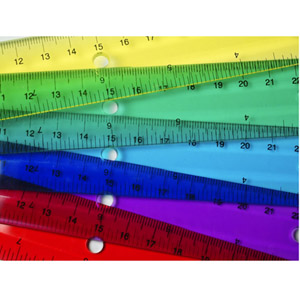
It’s common to use fractions in measurements – a quarter inch, a half centimeter. We have to have a way of naming measurements that are in between whole number measurements. If you’re working on measurement with your child, you’re probably using mixed numbers (e.g., 2 1/2 inches) rather than improper fractions. But go ahead and try to make the leap. If something measures 2 1/2 inches, ask: “How many half inches is that?” or “How many quarter inches is it?” This is more for older children – this is more challenging than pizza where you can see and hold and count an eighth. But it never hurts to ask something that’s beyond the child, and come back to it later if you find it’s beyond the child’s current capacity.

ruler


* As an aside, a colorful set of plastic measuring cups and spoons (maybe even one with a 1/8-cup measure) is a great Christmas or birthday gift for a child. It’s not terribly expensive, and opens up opens up all sorts of opportunities for experiences, creativity, and one-on-one time with parents or older siblings and (bonus!) they have their very own tool for thinking about and reasoning with fractions in a completely natural context.


Scavenge for Quantity

The beginning of the college semester has kept me extra busy for a couple weeks, but I’m back. And I have a game this time that can be adapted for a very wide variety of ages – a scavenger hunt!

One way to help your child to internalize mathematical thinking is to open their eyes to the quantities around them. As parents, we help provide our children ways to see the world from an early age. We name objects, identify colors, describe what we’re doing. A child doesn’t necessarily see the color blue on their own – they see blue because adults point blue out to them (listen to this totally fascinating Radiolab podcast about the color blue). We point out big and little, noisy and quiet, dark and bright – we help show them which characteristics are worth noticing.

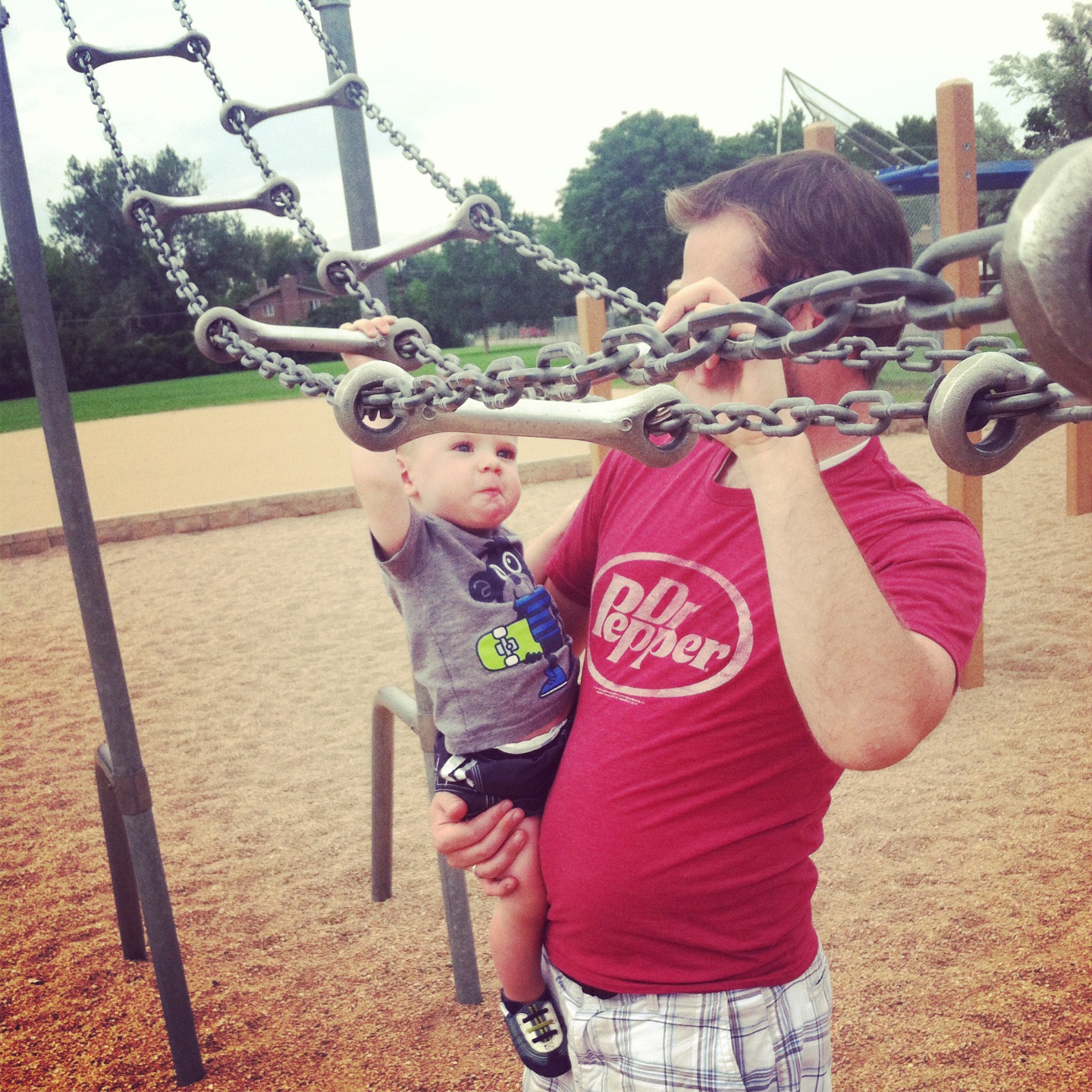
Quantity is also a characteristic. So many things in our world come in quantities, but since kids don’t tune in naturally to the characteristic “how many,” adults can help by pointing it out. I’m not talking about learning to count – I’m talking about learning to see quantity as an attribute, something we can recognize, describe, and use to characterize parts of our world, just like color. Just as Monkey’s t-shirt and the playground equipment in the picture below, although entirely different in other ways, share the attribute “gray,” the flower petals and the dots on the dice below the photograph share the attribute “five.”

IMG_1689

flower dice

A scavenger hunt for quantities can help your child become accustomed to seeing quantity as an attribute. There are all sorts of ways to do a quantity scavenger hunt. Here are three:

  1. Open Scavenge: Pick a room in the house and work together to find as many quantities as possible. You might choose the kitchen and find that there are two salt/pepper shakers, six chairs around the table, four drawers beneath the counter, three slats on the back of the chair, two towels on the front of the oven, and so on and so on. This can be played one-on-one with a single child or cooperatively with two or more children. Some children may enjoy labeling quantities with sticky notes or a label maker.
  2. Number Challenge: Give your child (or children) a paper labeled with the numbers 1-12, or a set of sticky notes labeled 1-12. Then roam throughout the house and try to find a quantity for every number. With multiple players, everyone can have their own set, the rule being that no two people can choose the same set of objects for their number. Because some numbers will be much harder than others (how many things come in sets of 11?*), you may wish to eliminate hard numbers, set a time limit, or simply play for fun with the expectation that you might not find everything.
  3. Quantity Match: Can be played with a parent and child, or with two children. Have one player find a quantity (four shelves, for example). The other player then has to find something different, but with the same quantity (four pillows on the couch!). Then switch places. Repeating quantities is okay (and even repeating sets of objects for very young children).

Again, this is really easy to adapt, and it’s easy to involve multiple members of the family – including younger and older children. Have fun with it!

scavenge

And as a side note, it’s never to early to start helping your child notice quantity. With very young children, you can point out any quantity but especially two – there are all sorts of twos in a baby or toddler’s life! Two ears, two hands, two feet… This morning as I was changing 16-month-old Monkey out of his pajamas, I counted “one…” as I pulled one foot out of the footie, and as I reached for his second foot he responded with, “dooh!” A few more repetitions convinced me that it wasn’t just coincidence – he’s picked up on the “one…two!” count he’s been hearing from me, and I wasn’t even really thinking about it. Way to make your math mama proud, Monkey!


* Look! 11 slats on the shoe rack!

IMG_0503

Reading Share: 5 Ways To Help Your Kid Not Stink At Math (NY Times)

Recently the New York Times magazine published an article on the recent history of math education in the U.S., written by Elizabeth Green. It’s a fantastic read for anyone who is at all invested in the education of children (which, of course, includes all parents!). I highly recommend it, and I’m looking forward to reading her new book, Building a Better Teacher.

But the article, while very readable, is also quite long. As a parent, and a parent who loves to read, I still may not have made it through if it wasn’t exactly up my alley. So if you’re looking for something shorter and directly relevant to how you interact with your kids around math, I’d like to point you to Elizabeth Green’s accompanying blog post on the New York Times parenting blog, Motherlode: 5 Ways To Help Your Kid Not Stink At Math. It contains excellent advice, and it’s solid – these are things that really work, no matter what math curriculum your child might be using.

While all 5 of her main points are good, my favorite is the first:

1. Listen to What’s Going Wrong

Teaching children math requires first figuring out what they don’t understand. Instead of getting to the heart of a misunderstanding, we are far more likely to tell children something like, “No, that’s not right, try it this way instead.” The better response to a wrong answer begins with asking the child to explain her thinking.

You’ll hear this from me over and over again, but the very best thing you can do to help your child, whether you’re encouraging a preschooler’s interest in numbers, or helping a high schooler with their math homework, is to make an effort to find out what they’re thinking.

Click over and take a look. And if you have other resources (books, articles – anything!) that have helped you as a parent to help your child with math, please share!